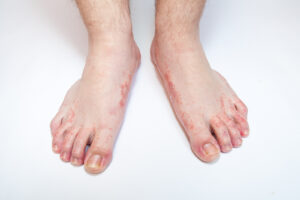
Symptoms
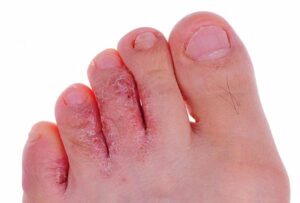
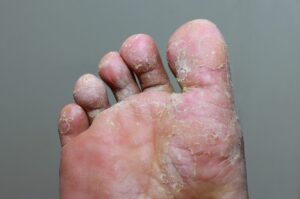
Symptoms typically start between the toes and spread on the soles and nails.
- irritation, itching and burning sensation,
- soreness,
- redness
- dry skin,
- cracked skin surface,
- scaling of the skin,
- blistering of the skin,
- moccasin type outlook (athlete’s foot).
Affected skin area
- between the toes,
- soles,
- bottom part of the foot – moccasin line,
- nails,
- hands: between the fingers,
- hands: nails.
Causes
- different fungi,
- fungi with the abilities to live on the dead, upper layer of the skin.
Predisposing factors
- all conditions that maintain warm and moist area of the skin,
- prolonged use of occlusive footwear,
- active sport,
- humid climate,
- poor foot hygiene,
- contact with infected humans and animals,
- diabetes,
- immunodeficiency.
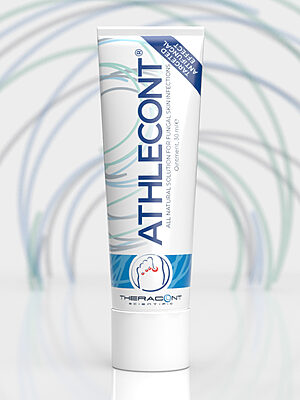
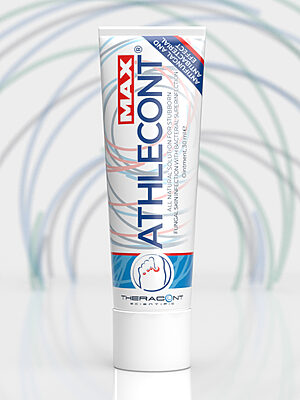
Use of ATHLECONT and ATHLECONT-MAX
– clean the affected skin area in the morning and at the end of the day (or ideally three times/day),
– apply the ointment on the affected area, by creaming it smoothly,
– wait till the ointment dries!
– avoid to step on the freshly treated area, therefore it is suggested to make treatments before sleeping, before or during wakeing up or during resting.
Mild fungal skin surface infections can occur quite often and it is enough to treat them with gentle treatments, like ATHLECONT, but stubborn cases, especially affected with bacterial superinfections require a broader spectrum of compounds, contained by ATHLECONT-MAX.
Facts about Athlete’s foot or Tinea Pedis or Onychomycosis
This infection is caused by dermatophytes, a class of fungal organisms able to degrade keratin and by this live on the dead layer (stratum corneum) of the skin. They are also able to subsist on hair and nails, but in contrast do not survive on unkeratinized living layers of skin and mucous membranes. Warm and moist support their survival and this is the reason why they mostly appear between the toes and the foot. Nearly 70% of the cases is caused by one species, Trychophyton rubrum, while rest of the cases are caused by T. tonsurans, T. entagrphytes, Microsporum canis and Epidermophyton floccosum.
Tinea pedis most often begins on the small toe, or in the groove between the fourth and fifth toes. The reason for this geographic predilection is that the fifth toe is most likely of all to be overcrowded in tight shoes, and its continued close proximity (moist and maceration) to the fourth toe etsablish ideal condition for growth. From this starting point tinea pedis is able to branch out in different forms.
According to the progress and symptoms Athlete’s foot -the most common fungal infection- has three basic forms, that all starts with mild infection forms:
1. Interdigital tinea pedis occurs among the toes. Begins to itch and break down. Fissures develop with accompanying maceration and cause a boggy appearance, with whitening and thickening. Intensive pruritus and burning develops and foul can appear in case of bacterial overgrowth.
2. Acute vesiculobus infection can occur as a second form of tinea pedis. The lesions include iflammed vesicles that restrict normal life and by this patients are disabled.
3. Moccasin type of tinea pedis is the third form in that patients notice fine scales all over the plantar surfaces. This form is often chronic and persists for years if not treated properly.
In these upper cases of purely fungal infections ATHLECONT is the proper ointment of choice.
But, scaled and broken skin opens the way for bacterial colonization and infection of the affected area and by this leads to bacterial superinfection. Due to the activity of bacteria one additional typical symptom can be observed like malodour or foul. It is important to emphasize that in this case however pits (like in case of Pitted Keratolysis) are not typical. If such superficial infection occurs both, fungus and bacteria have to be eliminated. For this purpose ATHLECONT-MAX is the choice of treatment.
Predisposing factors. The common name (athlete’s foot) of the condition reflects its typical occurence in this group. Predisposing factors are occlusive footwear and sweating. Common epidemiologic sites of infections are shared bathtubs and showers in locker rooms, summer camps, college dormitories, municipal swimming pools, gyms, sports clubs, steam rooms, boarding schools and army. Researches have also identified pets as risk factors of athlete’s foot, since pets can carry fungal organisms without showing any visible symptoms.
ATHLECONT and ATHLECONT-MAX mean a new trend in the treatment and control of Tinea Pedis. ATHLECONT is free of traditional antifungal antibiotics. Its antibacterial effect is based on natural active ingredients that specifically target fungi with aetiological importance of Athlete’s foot. As a result ATHLECONT effectively kills and inhibits the proliferation of fungi and by this eliminates unpleasant symptoms, while ATHLECONT-MAX contains not only antifungal, but also antibacterial compounds and by this eliminates bacterial superinfection.