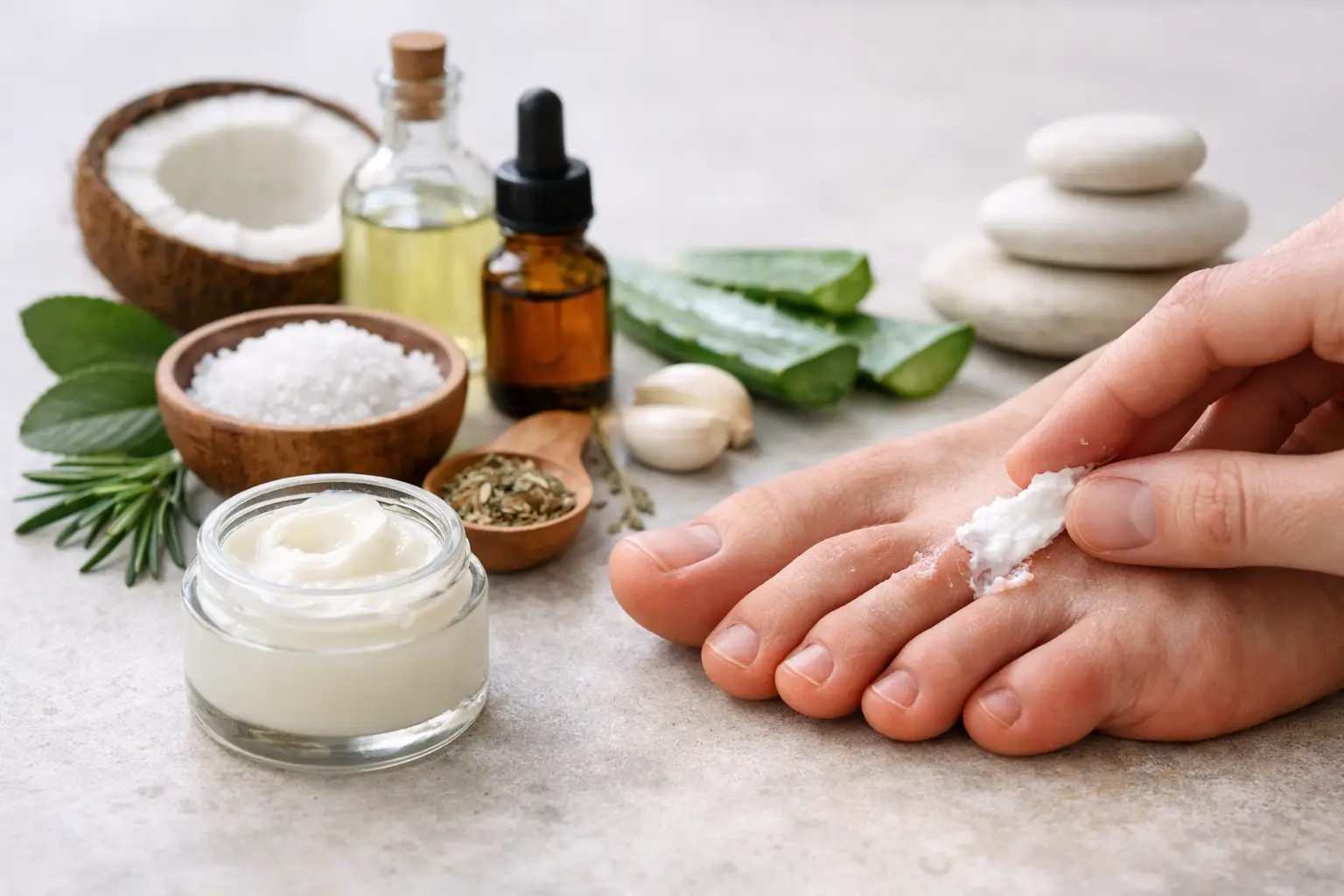
Athlete’s foot rarely stays small for long. What starts as mild itching between the toes can turn into burning, peeling skin, cracking, odor, and a cycle that keeps coming back after you think it is gone. If you are looking for a natural ointment for athlete’s foot, the goal should not be a vague soothing cream. It should be a targeted topical that addresses fungal overgrowth while helping damaged skin recover.
Athlete’s foot, also called tinea pedis, is a fungal infection that thrives in warm, damp environments. Shoes, socks, gym floors, and sweaty skin create ideal conditions for it to spread and persist. That is why symptom relief alone is not enough. A formula may feel cooling on contact, but if it does not actively help control the fungal burden on the skin, the problem often returns.
What a natural ointment for athlete’s foot should actually do
A useful ointment has to do more than moisturize. In practical terms, it needs to help reduce fungal activity, calm itching and burning, and protect irritated skin long enough for the area to recover. That combination matters because athlete’s foot is both an infection problem and a skin-barrier problem.
When the skin between the toes becomes macerated, cracked, or inflamed, it gets easier for fungi to keep spreading. The right topical approach supports both sides of the issue. It should deliver active natural compounds with known anti-infective properties while also forming a stable layer over damaged skin. Ointments are often well suited for this because they tend to stay in place longer than lighter creams or gels.
This is also where product specificity matters. A generic natural balm may contain botanical ingredients, but that does not make it a treatment. For athlete’s foot, you want a condition-specific ointment designed around fungal control and symptom relief, not a general wellness product repurposed for infected skin.
Why many foot fungus products fall short
A common problem in the over-the-counter market is that products are either too general or too harsh for repeated use on compromised skin. Some formulas focus on temporary cooling or deodorizing. Others rely on a narrow treatment concept but neglect the irritation, dryness, or scaling that make the condition so uncomfortable.
That trade-off matters. If a product is unpleasant to use, people tend to stop too early or apply it inconsistently. If it only softens the skin without helping control the infection, the fungus remains active under the surface. Consistency is a major part of successful treatment, so the ointment has to be practical as well as effective.
Natural products can fall into the same trap when they are marketed with broad claims but little therapeutic focus. Tea tree oil is often mentioned for fungal skin issues, and some people do respond to it. But concentrated essential oils can also irritate already inflamed skin, especially in toe webs where the barrier is fragile. Natural treatment is not automatically gentle, and gentle is not automatically effective. A better standard is targeted, tolerable, and designed for repeated use.
How to evaluate a natural ointment for athlete’s foot
Start with the intended use. If the product is described as a general skin salve, body balm, or multipurpose moisturizer, it may not be built for tinea pedis. Look for language that clearly identifies athlete’s foot or fungal skin infection as the target condition.
Next, consider the active strategy. A serious product should be built around natural compounds selected for antifungal or anti-infective action, not just fragrance, cooling sensation, or cosmetic feel. It should also acknowledge the symptoms people are actually trying to stop: itching, burning, scaling, redness, irritation, and odor.
Form matters too. Ointments can be especially useful when the skin is dry, cracked, or peeling because they provide more staying power and skin coverage. On the other hand, if the area is very wet and macerated, some people may need to focus first on keeping the skin dry between applications. It depends on how the infection presents. Athlete’s foot is not always the same from person to person.
When an ointment makes more sense than a cream or spray
Sprays are convenient, especially for people who do not want to touch affected skin. They can also be helpful for shoe interiors or broad coverage around the foot. But sprays do not always give prolonged contact on thickened, flaky, or cracked areas.
Creams can feel lighter and may absorb faster, which some users prefer for daytime application. The drawback is that lighter vehicles may not protect damaged skin as well in high-friction areas.
An ointment is often the better choice when the skin is rough, irritated, and persistently symptomatic. It stays where you put it, helps shield the area, and can support longer exposure to the active ingredients. For recurrent athlete’s foot, that can make day-to-day treatment more manageable.
Signs your athlete’s foot may need a more targeted approach
If symptoms keep returning after basic treatment, that usually points to one of three issues. The product may not be strong or specific enough, application may be inconsistent, or the environment around the foot is still favoring fungal growth.
Recurring signs include itching that settles down and then returns, peeling skin between the toes, burning after sweating, persistent odor, or scaling on the sole that never fully clears. Some cases also spread to the toenails, where treatment becomes more difficult and slower. Once nails are involved, a simple comfort cream is even less likely to be enough.
This is one reason condition-specific natural topicals have a place. They can give consumers an over-the-counter option that is not just symptom masking and not just another generic skincare product. Theracont Scientific builds its topical ointments around that exact idea: targeted, natural anti-infective care for specific skin conditions rather than one-size-fits-all creams.
How to use a natural ointment for athlete’s foot effectively
Application technique affects results more than many people realize. Wash the feet, dry them thoroughly, and pay close attention to the spaces between the toes before applying any ointment. If moisture stays trapped under the product, improvement can be slower.
Apply a thin, even layer over the affected area and a small margin beyond the visible rash. Fungal spread is not always limited to the most irritated skin. Use the product as directed and continue long enough to fully address the infection, not just until the itching drops.
You also need to manage reinfection pressure. Change socks regularly, rotate shoes so they can dry out, and avoid staying in damp footwear. If you treat the skin but ignore the environment, recurrence becomes much more likely. This is especially true for people who exercise often, work in boots, or have feet that sweat heavily.
When natural treatment is appropriate and when to get medical care
Many mild to moderate cases of athlete’s foot can be managed with an over-the-counter topical, including a well-formulated natural ointment. That is often the most practical starting point for people who want direct access to treatment without a prescription.
Still, there are limits. If the foot is severely swollen, draining, intensely painful, or showing signs of bacterial infection, home treatment is not enough. The same is true if you have diabetes, poor circulation, major nail involvement, or a rash that does not improve after consistent use of an appropriate product. In those cases, medical evaluation is the safer move.
The point is not to treat every irritated foot with the same product and hope for the best. It is to match the treatment to the condition. A true athlete’s foot ointment should be antifungal in intent, supportive of skin recovery, and realistic for ongoing use.
Choosing relief that is targeted, not generic
There is a big difference between a natural product and a therapeutic natural product. For athlete’s foot, that difference shows up in results. The best option is not the one with the longest ingredient story or the strongest scent. It is the one formulated to help control fungal overgrowth, reduce symptoms, and support healing skin without pushing you toward unnecessary antibiotic use.
If your feet are itching, burning, peeling, or developing the familiar cycle of odor and irritation, choose a product that treats the problem like an infection, not a minor cosmetic issue. A focused natural ointment can be a practical way to get relief and regain control before the condition gets more stubborn.