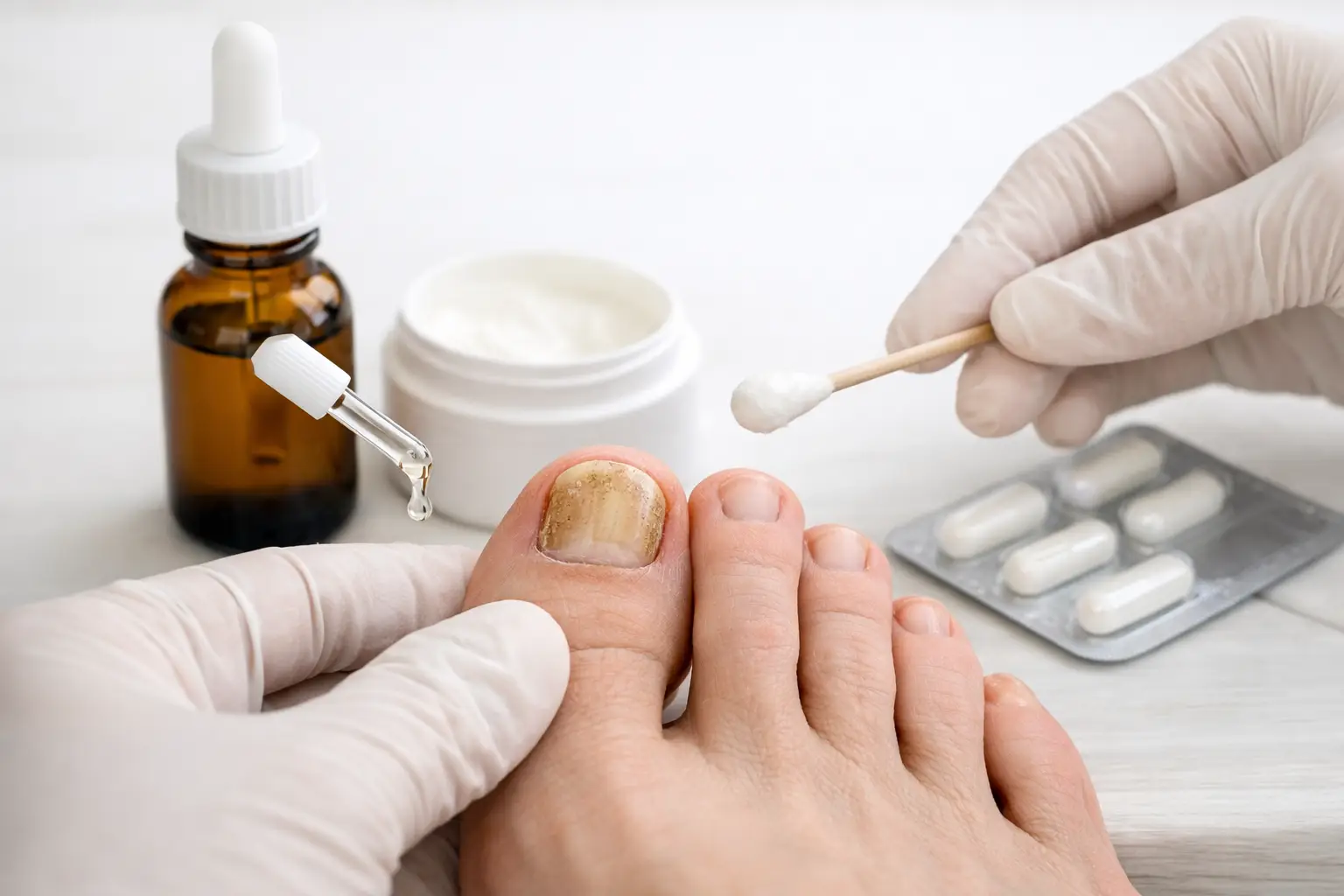
A thickened yellow toenail usually does not start as a cosmetic problem. It starts as a fungal infection that slowly takes over the nail plate, builds debris under the nail, changes the nail’s color, and makes the nail harder to trim, harder to clean, and harder to ignore. For many adults, onychomycosis treatment without prescription is the first practical step because the condition is common, persistent, and often manageable at home when caught early.
What nail fungus actually does
Onychomycosis is a fungal infection of the nail unit, most often affecting toenails. The organisms involved usually thrive in warm, damp environments and gain access through small cracks in the nail, minor trauma, or skin already affected by athlete’s foot. Once established, the infection can spread deeper into the nail structure, which is exactly why nail fungus is slower to treat than surface-level skin irritation.
That depth matters. A nail is not living skin. Topical products have to work through or around a dense nail plate to reach the infected area. This is why many consumers try one over-the-counter product for a week or two, see little change, and assume nothing works. In reality, visible improvement often depends on new, clearer nail growth, and that takes time.
When onychomycosis treatment without prescription makes sense
Non-prescription treatment is often a reasonable starting point when the infection is mild to moderate, limited to part of one or two nails, and not causing severe pain, drainage, or swelling. It is also a practical option for people who want to avoid prescription medications, prefer natural topical care, or want to act early before the infection becomes more extensive.
There is a trade-off, though. Over-the-counter treatment is generally best for localized disease. If the nail is severely thickened, lifting off the nail bed, affecting multiple nails, or accompanied by significant redness and tenderness around the nail, home care may not be enough on its own. The more advanced the infection, the harder it is for a topical product to do the full job without clinical support.
What to look for in a non-prescription nail fungus treatment
Not all OTC antifungal options are designed with nail infections in mind. Many are better suited for athlete’s foot on the surrounding skin than for a fungus protected by a nail plate. If you are looking for a targeted onychomycosis treatment without prescription, the formulation matters as much as the ingredient list.
A useful product should do three things well. It should target fungal overgrowth directly, it should be practical for repeated long-term use, and it should also address the symptoms and surrounding conditions that help fungus persist, such as scaling skin, moisture retention, and irritation around the nail folds.
For consumers who prefer natural anti-infective care, condition-specific topical ointments can be especially appealing. The advantage is not simply that they are plant-derived. The real advantage is when natural active compounds are chosen and formulated for a defined antifungal purpose instead of being sold as a vague wellness solution. Nail fungus requires focused treatment, not a generic moisturizer with a botanical label.
How to improve the odds of success at home
Home treatment works better when the infected nail is prepared consistently. Before applying any topical product, wash and dry the foot thoroughly. Trim the nail straight across, reduce loose or crumbly material if possible, and keep the surface clean. If the nail is very thick, gentle filing can help reduce the barrier that prevents the treatment from reaching the affected area.
Application technique matters more than many people realize. The product should go over the nail surface, under the free edge when accessible, and around the surrounding skin where fungal spread often continues. Missing the skin around the nail can leave a reservoir of infection in place.
Just as important, footwear and hygiene need attention during treatment. Repeated exposure to damp socks, occlusive shoes, and untreated athlete’s foot will keep reintroducing fungus to the same area. If the skin on the feet is peeling, itchy, or burning between the toes, that should be treated at the same time. Nail fungus rarely exists in isolation.
What results are realistic
One of the most common mistakes in treating nail fungus is measuring progress by how the damaged part of the nail looks after a few days. Fungal nails do not clear overnight. The damaged portion usually has to grow out over weeks and months. Early signs that a treatment is helping may include less debris buildup, reduced odor, less irritation around the nail, and a cleaner band of new growth near the cuticle.
Toenails grow slowly, so visible recovery takes patience. That does not mean the treatment is failing. It means the biology of the nail is slow. Consistency is often the difference between improvement and relapse.
This is where many adults benefit from a therapeutic, no-nonsense approach. A targeted OTC product that is easy to apply, designed for repeated use, and focused on fungal control is far more useful than a complicated routine people abandon after ten days.
Common reasons OTC treatment fails
Sometimes the issue is not the treatment itself but the way the condition is being managed. Stopping too early is a major reason fungal nails persist. Another is treating only the nail while ignoring infected skin on the feet. Reinfection from shoes, socks, shower floors, and adjacent nails is also common.
There is also the possibility of misidentification. Not every discolored or thickened nail is fungal. Nail psoriasis, repeated trauma from running or tight shoes, and other nail disorders can look similar. If a non-prescription product is used steadily and there is no sign of healthier nail growth over time, the diagnosis may need a closer look.
The final issue is severity. Once a nail becomes markedly thick, distorted, painful, or extensively separated from the nail bed, topical management becomes more limited. At that stage, even a well-formulated non-prescription product may serve better as supportive care than as a complete answer.
Choosing a targeted approach instead of a generic one
Consumers often default to broad drugstore options because they are familiar, not because they are the best fit. But onychomycosis is a specific infection with specific barriers to treatment. It responds better to products developed for fungal nail involvement and the surrounding infected skin, rather than all-purpose creams meant for occasional itch.
That targeted approach is where scientifically informed natural care has a real place. A well-designed antifungal ointment can offer over-the-counter accessibility while still focusing on infection control, symptom relief, and repeated use over the full treatment window. For people who want to avoid unnecessary escalation to synthetic therapies unless truly needed, that can be a sensible first-line option.
Theracont Scientific reflects that model by focusing on condition-specific anti-infective topicals rather than generic skin creams. For consumers dealing with stubborn fungal nail changes, that distinction matters.
When to stop self-treating and get medical evaluation
There is nothing wrong with starting at home, but there should be a clear threshold for escalating care. If the nail becomes painful, the surrounding skin becomes red or swollen, there is drainage, the infection spreads to multiple nails quickly, or you have diabetes, poor circulation, or immune compromise, professional evaluation is the safer move.
The same is true if the nail is blackened without obvious injury, if the nail disorder is not clearly fungal, or if months of careful OTC use produce no meaningful improvement. Persistent nail disease deserves an accurate diagnosis. A fungal infection needs antifungal management, but a non-fungal nail disorder needs a different plan.
A practical standard for home treatment
The most effective non-prescription strategy is usually not aggressive. It is disciplined. Keep the nail trimmed, keep the foot dry, treat the surrounding skin, apply a targeted product consistently, and give the nail enough time to show healthier growth. That is how OTC care has the best chance to work.
For many adults, onychomycosis treatment without prescription is not about finding a miracle fix. It is about using the right topical treatment early, using it correctly, and staying with it long enough to interrupt a stubborn fungal cycle. If you treat the infection seriously from the start, you give the nail a real chance to grow back clearer, stronger, and easier to live with.