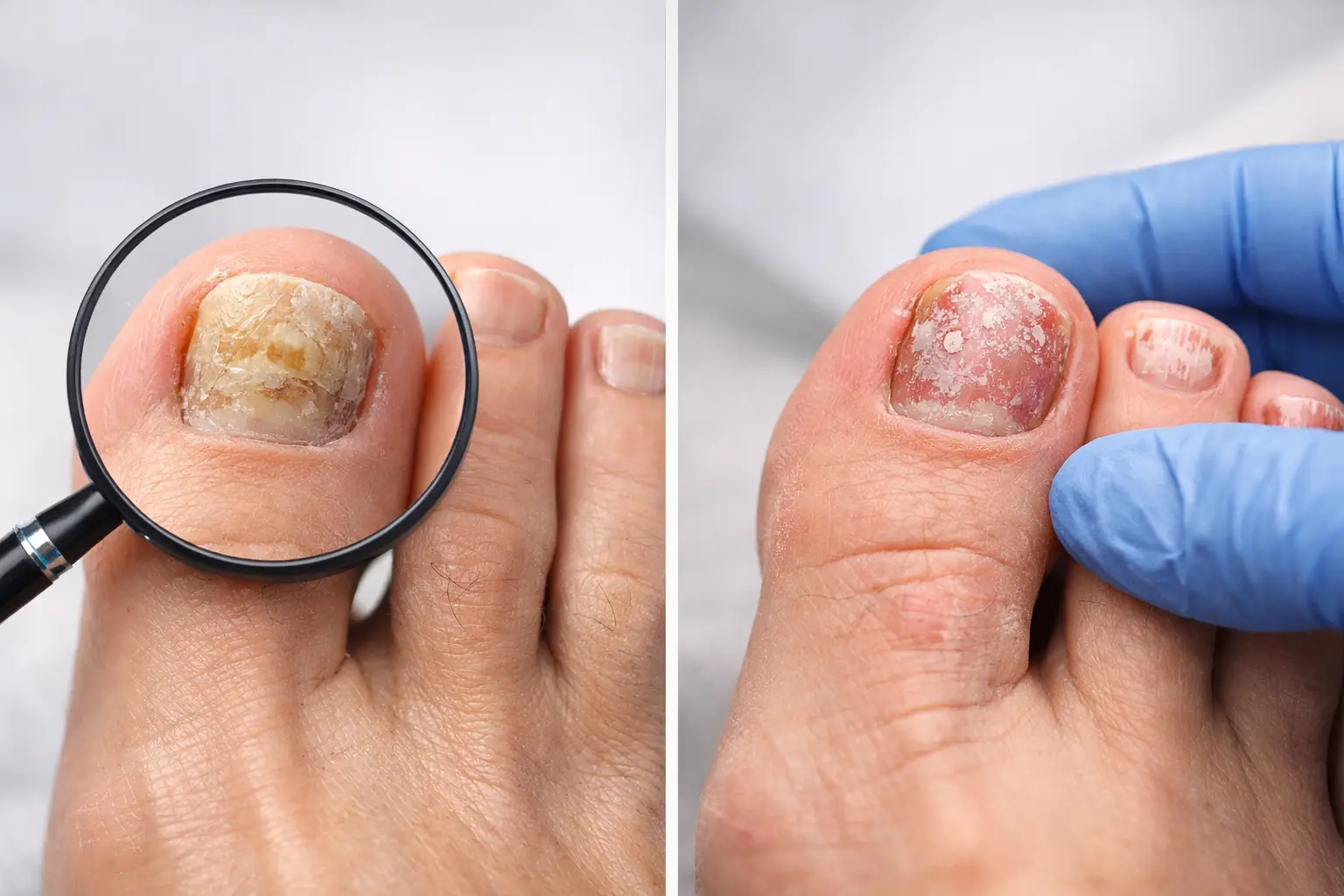
When a toenail turns yellow, thick, rough, or brittle, most people assume fungus. That is often true – but not always. The problem with toenail fungus vs nail psoriasis is that both can distort the nail in ways that look nearly identical at first glance, and treating the wrong condition can waste months.
If you are trying to figure out why a nail is lifting, crumbling, or changing color, the details matter. Fungal nail infection and nail psoriasis can overlap in appearance, but they do not start for the same reason, and they do not respond to the same treatment approach.
Toenail fungus vs nail psoriasis: why they get confused
Toenail fungus, also called onychomycosis, is an infection caused by fungal organisms that invade the nail plate, nail bed, or both. It often develops slowly and tends to thrive in warm, damp environments, especially in people with athlete’s foot, sweaty feet, tight shoes, nail trauma, or shared locker room exposure.
Nail psoriasis is different. It is not an infection. It is an inflammatory nail disorder linked to psoriasis, an immune-mediated condition that affects skin and sometimes joints. In some people, nail changes happen with visible skin plaques. In others, the nails are involved before psoriasis is obvious elsewhere.
That is why misidentification is common. Both conditions can cause thickening, discoloration, nail separation, and surface damage. A nail can even have both fungal infection and psoriasis at the same time, which makes the picture even less straightforward.
What toenail fungus usually looks like
Fungal nail infection often starts at the edge or corner of the nail and gradually spreads inward. The nail may become yellow, white, or brown. Over time it often turns thicker, more brittle, and harder to trim.
One of the more suggestive signs is debris building up under the nail. That material can look chalky, crumbly, or compacted. Many infected nails also begin to lift away from the nail bed, a process called onycholysis. When this happens, the detached portion may look opaque or darker than the healthy part of the nail.
The surrounding skin can offer clues too. If you also have peeling, itching, scaling, or burning between the toes or on the sole, fungal involvement becomes more likely. Toenail fungus commonly travels with tinea pedis, especially in recurrent cases.
The pace matters as well. Fungal changes usually progress steadily unless treated. A nail rarely returns to normal on its own if active infection is still present.
What nail psoriasis usually looks like
Nail psoriasis can produce a different pattern, although there is overlap. Small dents in the nail surface, called pitting, are one of the classic features. Some nails develop irregular ridges, surface roughness, or a patchy appearance rather than a uniform thickening.
Color change can also look different. Instead of the typical yellowed fungal pattern, psoriasis may create salmon-colored or reddish-brown spots beneath the nail, sometimes called oil-drop discoloration. The nail may separate from the nail bed, and the exposed area can turn white or yellow, which is one reason it gets mistaken for fungus.
Psoriatic nails may also crumble, thicken, or become tender. In more advanced cases, the entire nail unit can become distorted. If someone already has psoriasis on the scalp, elbows, knees, or lower back, or has a history of psoriatic arthritis, nail psoriasis moves much higher on the list.
Unlike fungus, psoriasis is not contagious. It does not come from public showers, shoe exposure, or skin-to-skin spread. That distinction matters for treatment and for expectations.
The key clues in toenail fungus vs nail psoriasis
The fastest way to think about toenail fungus vs nail psoriasis is to look at pattern, texture, and context rather than one symptom alone.
Fungus is more likely when the nail has subungual debris, progressive thickening, yellow-brown discoloration, and a history of athlete’s foot or moist shoe exposure. It often affects one or several nails in an uneven way, particularly if one nail was damaged or repeatedly traumatized.
Psoriasis is more likely when you see pitting, oil-drop discoloration, multiple nails with similar inflammatory changes, or known psoriasis elsewhere on the body. It can affect fingernails and toenails together, and the nail surface often looks more irregular than simply infected.
Still, there is no single visual sign that settles it every time. A thick yellow nail is not automatically fungal, and a pitted nail is not automatically psoriatic. That is where testing becomes useful.
Why self-diagnosis often goes wrong
People commonly start an antifungal product after noticing a discolored toenail. If the nail is actually psoriatic, the result is frustration. The nail does not clear, and the condition may continue to worsen while the real cause goes untreated.
The reverse also happens. Some people assume their nail changes are part of psoriasis and ignore the possibility of fungal invasion. That matters because untreated fungal infection can spread to nearby nails, persist for long periods, and continue to trigger discomfort, odor, and cosmetic damage.
There is also a mixed scenario. Psoriatic nails are structurally abnormal, and damaged nails can be more vulnerable to secondary fungal infection. So if a nail has features of both, it may not be an either-or situation.
How diagnosis is confirmed
A clinician can often make an educated assessment by examining the nails, feet, and skin, but visual inspection is not always enough. For suspected fungus, confirmation may involve a nail clipping, scraping, fungal stain, culture, or laboratory analysis of nail material.
That testing is valuable because antifungal treatment can take months, and you want to be treating an actual infection. If the nail changes are psoriatic, management typically centers on controlling inflammation rather than killing organisms.
If you have nail changes plus joint pain, swollen fingers or toes, chronic skin plaques, or a strong family history of psoriasis, those details should be mentioned early. They can shift the diagnostic picture.
Treatment is where the difference really matters
Toenail fungus requires antifungal therapy. Depending on severity, that may include topical treatment, oral antifungal medication, nail debridement, or a combination approach. Mild to moderate superficial cases may respond to targeted topical care, especially when treatment is started early and used consistently.
This is where a condition-specific approach matters. A focused topical antifungal product is designed to reduce fungal burden at the site, support symptom relief, and address the contaminated nail environment without defaulting to broader synthetic drug exposure when it is not necessary. For consumers seeking non-prescription options, that can be a practical first step in straightforward cases.
Nail psoriasis is managed differently. Topical steroids, vitamin D analogs, intralesional therapy, or systemic psoriasis treatment may be used depending on severity and whether skin or joint disease is also active. An antifungal will not correct an immune-driven nail disorder unless fungus is also present.
That is the central problem in toenail fungus vs nail psoriasis. Similar appearance does not mean similar treatment.
When to suspect fungus, psoriasis, or both
If the nail change began after athlete’s foot, repeated shoe friction, nail trauma, or long-term damp foot conditions, fungus becomes more likely. If you also notice scaling on the feet and the nail is packed with crumbly debris, that points even more strongly toward infection.
If the nails show pitting, irregular surface defects, or multiple nail changes alongside skin psoriasis or joint symptoms, psoriasis deserves serious consideration. If an antifungal has been used correctly for months with no change at all, it is reasonable to reassess the diagnosis rather than just changing brands.
If the nail is very thick, painful, rapidly worsening, or affecting daily walking, professional evaluation is the better move. The same is true for people with diabetes, poor circulation, immune compromise, or repeated recurrence.
A practical next step
Do not judge the condition by color alone. Look at the whole picture – nail texture, debris under the nail, nearby skin symptoms, personal history of psoriasis, and how the problem started.
If the signs point to fungal infection, early targeted treatment gives you a better chance of controlling it before more of the nail is involved. If the features suggest psoriasis, getting the diagnosis right can spare you months of ineffective antifungal use. Theracont Scientific takes that distinction seriously because infected nails need anti-infective action, while inflammatory nail disease needs a different plan.
A damaged toenail can be stubborn, but the right question is not how bad it looks. It is whether you are treating the cause.