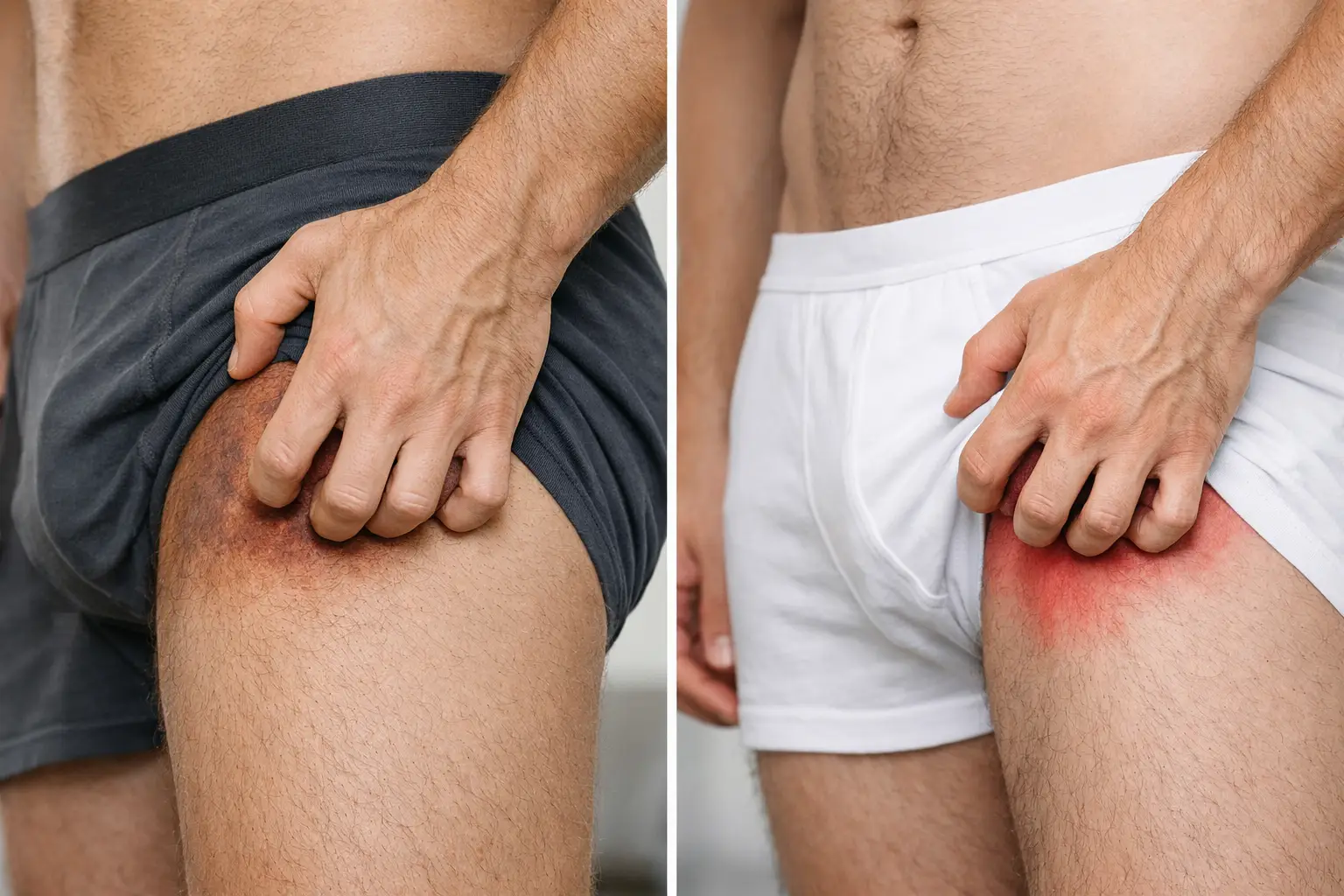
If you are dealing with a groin or skin-fold rash that will not clear, the difference between erythrasma vs jock itch symptoms matters more than most people realize. These two conditions can look similar at first glance, but they do not come from the same type of overgrowth, and they do not always respond to the same treatment. Getting that distinction wrong can leave you treating a bacterial problem like a fungal one, or the reverse.
Both conditions tend to show up in warm, damp, high-friction areas. The groin is common, but so are the inner thighs, buttock crease, underarms, beneath skin folds, and between the toes. That overlap is exactly why people confuse them. The details of the rash – its color, texture, border, odor, and level of itching – are usually what point you in the right direction.
Erythrasma vs jock itch symptoms at a glance
Jock itch, also called tinea cruris, is a fungal infection. Erythrasma is a superficial bacterial infection, most often linked to Corynebacterium minutissimum. That difference is not academic. It directly affects what kind of topical care is likely to help.
Jock itch usually causes a red to reddish-brown rash with a clearer, more active edge. Many people notice itching first. The rash may spread outward in a ring-like or semicircular pattern, with scaling around the border. In some cases, the center looks less inflamed than the outer edge.
Erythrasma often appears more flat and more uniformly discolored. The patch may look brown, reddish-brown, pink-brown, or slightly brick red. Instead of a raised ring, it tends to have finer scale and smoother borders. Itching can happen, but it is often milder. Some people notice tenderness, mild burning, or a persistent musty odor rather than intense itch.
How erythrasma usually looks and feels
Erythrasma often develops slowly. It may begin as a well-defined patch in a moist fold and gradually expand. In the groin or underarms, the skin can look dry, wrinkled, and finely scaly, almost as if the top layer has been dusted with powder. The color is frequently what gives it away. Rather than the bright inflammation many people expect from a rash, erythrasma may look dull brown or reddish-brown.
Odor can be a useful clue. Because this is a bacterial overgrowth in a warm, occluded area, some cases come with noticeable malodor. That is especially true when sweating, friction, and poor air circulation are involved. The skin may feel irritated, but many patients describe the discomfort as persistent and annoying rather than sharply itchy.
Erythrasma is also more common in people with diabetes, obesity, heavy sweating, or recurrent skin-fold moisture. It tends to persist when the underlying environment stays the same. That is why drying the area and reducing friction matter as much as the topical approach.
How jock itch usually looks and feels
Jock itch often announces itself with itching. Sometimes the itching starts before the rash becomes obvious. The rash is usually redder than erythrasma and often has a more defined, advancing border. That edge may be scaly, slightly raised, or more irritated than the skin inside it.
The classic location is the inner thighs and groin folds, though the scrotum is often less involved than surrounding skin. Many cases spread after sweating, exercise, tight clothing, or transfer from athlete’s foot. If someone has both foot fungus and a groin rash, a fungal cause becomes more likely.
Burning, chafing, and scaling are common. Some cases stay mild. Others become inflamed enough to interfere with walking, workouts, or sleep. When the border is active and the center looks somewhat clearer, jock itch moves higher on the list.
The symptom differences that matter most
When comparing erythrasma vs jock itch symptoms, the first question is not simply, “Does it itch?” Both can itch. The better question is how the rash behaves.
Color is one clue. Erythrasma often leans brown, pink-brown, or muted red-brown. Jock itch more often looks red, inflamed, or sharply irritated. Border shape is another clue. Jock itch tends to have a more obvious edge with outward spread. Erythrasma tends to look flatter and more evenly distributed across the patch.
Texture also helps. Erythrasma usually has fine scaling with a smoother surface. Jock itch often has more visible scaling at the border. Odor is another dividing line. A noticeable musty or unpleasant smell can point more strongly toward bacterial involvement, though it is not exclusive.
Then there is severity of itch. Jock itch is often itch-dominant. Erythrasma may itch mildly, but discoloration, irritation, and persistence are often bigger complaints than itch alone.
Why people misidentify these rashes
Skin-fold rashes are messy in real life. Sweat, friction, shaving, heat, and occlusion can blur the picture. On top of that, mixed infections happen. A person may have fungal overgrowth in one area and bacterial overgrowth in another, or both in the same region. That means symptoms do not always follow a textbook pattern.
It also means partial improvement can be misleading. If a product reduces irritation but does not address the actual cause, the rash may look better briefly and then return. This is one reason recurrent groin and fold rashes deserve a more targeted approach rather than repeated guesswork.
When diagnosis gets more precise
A clinician can often tell the difference by exam, but not always. One useful diagnostic clue for erythrasma is coral-red fluorescence under a Wood’s lamp, caused by bacterial porphyrins. That finding is not something most people can confirm at home, but it explains why erythrasma can be identified more confidently in a clinical setting.
Jock itch may be confirmed through skin scraping and fungal testing when needed. In straightforward cases, providers may diagnose based on appearance and distribution alone. If the rash is recurrent, widespread, painful, draining, or not responding to treatment, more careful evaluation matters.
Treatment depends on the cause
This is where the distinction becomes practical. Jock itch typically responds to antifungal care. Erythrasma requires antibacterial management. If a rash is bacterial, standard antifungal-only products may not do enough. If it is fungal, antibacterial care alone may not clear it.
There is also the issue of overusing antibiotics when they are not necessary. A more targeted, condition-specific approach makes sense, especially for superficial infections that may respond to focused topical care. For adults who want over-the-counter options, this is where understanding the pattern of symptoms can help narrow the likely cause before choosing a product.
Supportive skin care matters in both cases. Keep the area clean and dry. Change out of sweaty clothes quickly. Use breathable fabrics. Reduce friction wherever possible. If athlete’s foot is present, address that too, because fungal spread from the feet to the groin is common.
For bacterial fold infections such as erythrasma, targeted topical care designed for bacterial overgrowth may be more appropriate than generic anti-itch creams. For fungal rashes such as jock itch, antifungal treatment is usually the better fit. Theracont Scientific focuses on condition-specific topical support for bacterial and fungal skin infections, which is the right mindset for recurrent rashes that have not responded to one-size-fits-all products.
When to stop self-treating
If the rash is severe, spreading quickly, cracked open, draining, or very painful, it is time for medical evaluation. The same is true if you have diabetes, immune compromise, repeated recurrences, or a rash that keeps returning after treatment. Groin rashes can also overlap with contact dermatitis, inverse psoriasis, candida, and other conditions that need different management.
A good rule is simple: if you have treated it consistently and the symptoms do not match the expected response, reassess the diagnosis. A fungal rash that does not improve at all may not be fungal. A brown, persistent, mildly scaly fold rash with odor may not be simple jock itch.
The clearest way to think about erythrasma vs jock itch symptoms
Think in patterns, not single symptoms. Jock itch is more likely when itching is prominent, the rash is redder, and the border is active and scaly. Erythrasma is more likely when the patch is flatter, browner, finely scaly, persistent in skin folds, and sometimes accompanied by odor.
That is not a perfect rule, because skin conditions do not always read the manual. Still, it is a useful filter. If your rash keeps coming back, the smartest next step is not trying random creams. It is matching the treatment to the likely cause so the skin has a real chance to clear.