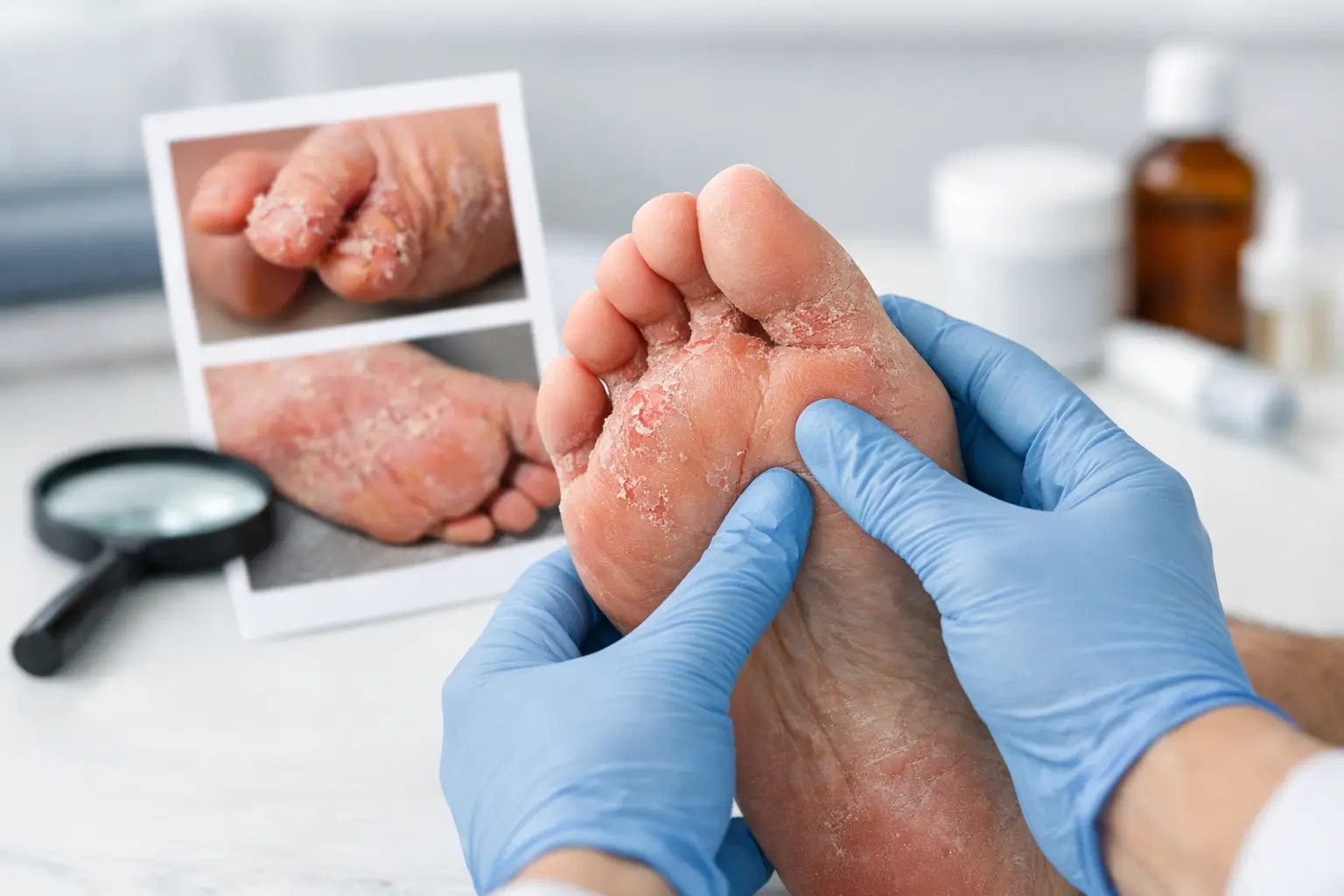
If your feet are itching, peeling, or starting to burn between the toes, searching for tinea pedis symptoms and pictures is usually about one thing – you want to know whether this is simple dry skin or a fungal infection that needs treatment. That distinction matters, because tinea pedis often starts subtly and then spreads when moisture, friction, and delayed care give fungus the environment it needs.
Tinea pedis, commonly called athlete’s foot, is a fungal infection of the skin on the feet. It often affects the toe webs first, but it can also involve the soles, sides of the feet, and in some cases the toenails. The infection can produce itching, scaling, redness, fissures, burning, and odor. In more advanced cases, the skin can become macerated, inflamed, or secondarily infected.
What tinea pedis symptoms and pictures usually show
When people look up tinea pedis symptoms and pictures, they are usually trying to compare one of three common patterns. The first is the classic interdigital form, which develops between the toes, especially the fourth and fifth toes. The second is the moccasin-type pattern, which causes diffuse scaling and dryness across the sole and edges of the foot. The third is the inflammatory or vesicular form, which can produce blisters and intense irritation.
Pictures of early tinea pedis often show whitish, softened skin between the toes with mild peeling at the edges. As the infection progresses, the area may look red, soggy, cracked, or eroded. On the sole, pictures often show fine scaling that resembles dry skin at first, but the distribution is more uniform and persistent. On the sides of the foot, you may see a defined scaly border. In the inflammatory form, images may show clusters of small fluid-filled blisters or raw irritated patches.
The problem with online image comparisons is that many foot conditions overlap in appearance. Eczema, contact dermatitis, psoriasis, friction injury, and bacterial overgrowth can all imitate fungal disease. That is why symptom pattern, location, odor, and recurrence all matter, not just appearance alone.
The most common symptoms of tinea pedis
Itching is often the first symptom people notice, especially after removing shoes and socks. The itch may be mild at first, then intensify with sweating, heat, or prolonged walking. Burning can follow, particularly when the skin becomes cracked or inflamed.
Scaling is another common sign. Instead of a little seasonal dryness, tinea pedis tends to produce skin flaking that lingers, spreads, or returns quickly after exfoliation or moisturizer use. The skin may look powdery, scaly, or rough, depending on the subtype.
Redness is frequent but not universal. In some people, especially with lighter skin tones, affected areas appear pink to red. In darker skin tones, the skin may look darker than the surrounding tissue, grayish, or inflamed without obvious redness. Pictures online do not always reflect this variation, which can make self-identification harder.
Cracking between the toes is one of the more recognizable signs. These fissures can sting, split with movement, and create openings that increase the risk of secondary bacterial infection. If the area becomes painful, swollen, or starts draining, that is no longer a simple cosmetic issue.
Odor can also develop, though odor alone does not confirm fungus. Tinea pedis can disrupt the skin barrier and trap moisture, creating conditions that allow bacteria to multiply alongside the fungal infection. That combination often leads to stronger malodor and more irritation.
How the infection looks by location
Between the toes
This is the most common site. Early changes may look like moist peeling skin or a pale white film between the toes. Later, the skin may become soft, soggy, cracked, and tender. Pictures of interdigital tinea pedis often show sharply affected toe webs with surrounding scaling.
On the sole and heel
Moccasin-type tinea pedis usually appears as diffuse dryness, thickened skin, and fine scaling across the bottom of the foot. It may affect one foot more than the other, though both feet can be involved. Some people mistake this pattern for simple callused or dehydrated skin and leave it untreated for months.
On the sides of the feet
Scaling along the lateral edge of the foot can be another clue. In pictures, this may appear as a band of dry, flaky skin with a subtle advancing border. When this pattern expands, it often suggests a fungal process rather than isolated irritation.
As blisters or inflamed patches
The vesicular form can be more dramatic. Small blisters may appear on the arch or instep, accompanied by itching and burning. These lesions are easy to mistake for allergic dermatitis or friction blisters, especially if only one area is affected.
What pictures cannot tell you on their own
Pictures are useful for pattern recognition, but they do not confirm the organism, severity, or whether another condition is present. A fungal infection can coexist with bacterial overgrowth, eczema, or nail fungus. If the skin is significantly tender, foul-smelling, swollen, or weeping, a more complicated infection may be developing.
Another limitation is stage. A mild case and a chronic case do not look the same. Early tinea pedis may show light peeling and intermittent itching. Chronic disease can cause persistent scaling, discoloration, fissures, and thickened skin that is harder to clear with basic foot hygiene alone.
When symptoms suggest more than a mild fungal infection
Tinea pedis is often manageable with focused topical care, but some signs point to a need for stronger evaluation. Pain is one of them. Uncomplicated fungal infections are usually itchy or irritating, but marked pain may mean the skin is broken down enough for bacteria to enter.
Rapid spreading redness, warmth, swelling, pus, or a foul odor should not be ignored. People with diabetes, reduced circulation, neuropathy, or immune compromise need to be especially cautious with any foot infection. In those cases, waiting and watching can lead to a more difficult problem.
If the rash keeps returning after temporary improvement, reinfection and incomplete treatment are both possible. Footwear, socks, communal showers, sweaty environments, and untreated nails can all keep the cycle going.
How to tell tinea pedis from dry skin or eczema
Dry skin usually improves with moisturization and does not consistently target the toe webs. Tinea pedis tends to persist despite lotion and often worsens in warm, moist conditions. If peeling increases after workouts, long days in shoes, or sweaty weather, fungus becomes more likely.
Eczema often causes itch and scaling too, but the pattern may be less concentrated between the toes and more associated with personal skin sensitivity. Psoriasis can also create thick scaling on the feet, sometimes with sharply defined plaques. The challenge is that self-diagnosis based on pictures alone can be wrong, especially in chronic cases.
A useful clue is whether there is associated nail change. Thickened, yellowed, brittle, or distorted nails can point to fungal involvement beyond the skin. If the nails are involved, treatment usually needs to be more deliberate and more persistent.
What effective care should target
Successful management is not just about making the feet feel better for a day or two. It should target the fungal burden, reduce moisture retention, calm inflammation, and protect damaged skin as it heals. That is why a condition-specific topical product generally makes more sense than a generic moisturizer or a multipurpose cream that does not directly address fungal overgrowth.
Natural topical antifungal care can be a practical option when it is formulated for active treatment rather than cosmetic relief. The goal is to suppress the organisms contributing to the infection while reducing itching, burning, scaling, and irritation. Theracont Scientific approaches this category with targeted anti-infective formulations designed for specific skin conditions rather than one-size-fits-all skin creams.
Consistency matters. Even a good topical product can underperform if it is used irregularly or stopped as soon as the itching fades. Fungal infections often improve in sensation before they fully clear on the surface.
Practical next steps if your symptoms match the pictures
If your symptoms resemble common tinea pedis pictures, start by looking at location, texture, and recurrence. Peeling or cracking between the toes, scaling on the sole, and itching that worsens with sweaty footwear all support the diagnosis.
Keep the feet clean and dry, especially between the toes. Change socks regularly, rotate shoes, and avoid trapping moisture after bathing or exercise. Then use a targeted topical antifungal approach long enough to treat the infection, not just the discomfort.
If the area becomes painful, rapidly inflamed, malodorous, or starts draining, do not treat it as routine athlete’s foot. Those changes suggest the skin barrier may be breaking down in a way that needs closer attention.
The most useful pictures are the ones that help you act early. If your feet are showing the classic signs – itching, scaling, redness, cracking, or recurring irritation – treating the infection directly is usually the fastest path back to comfort, mobility, and confidence.