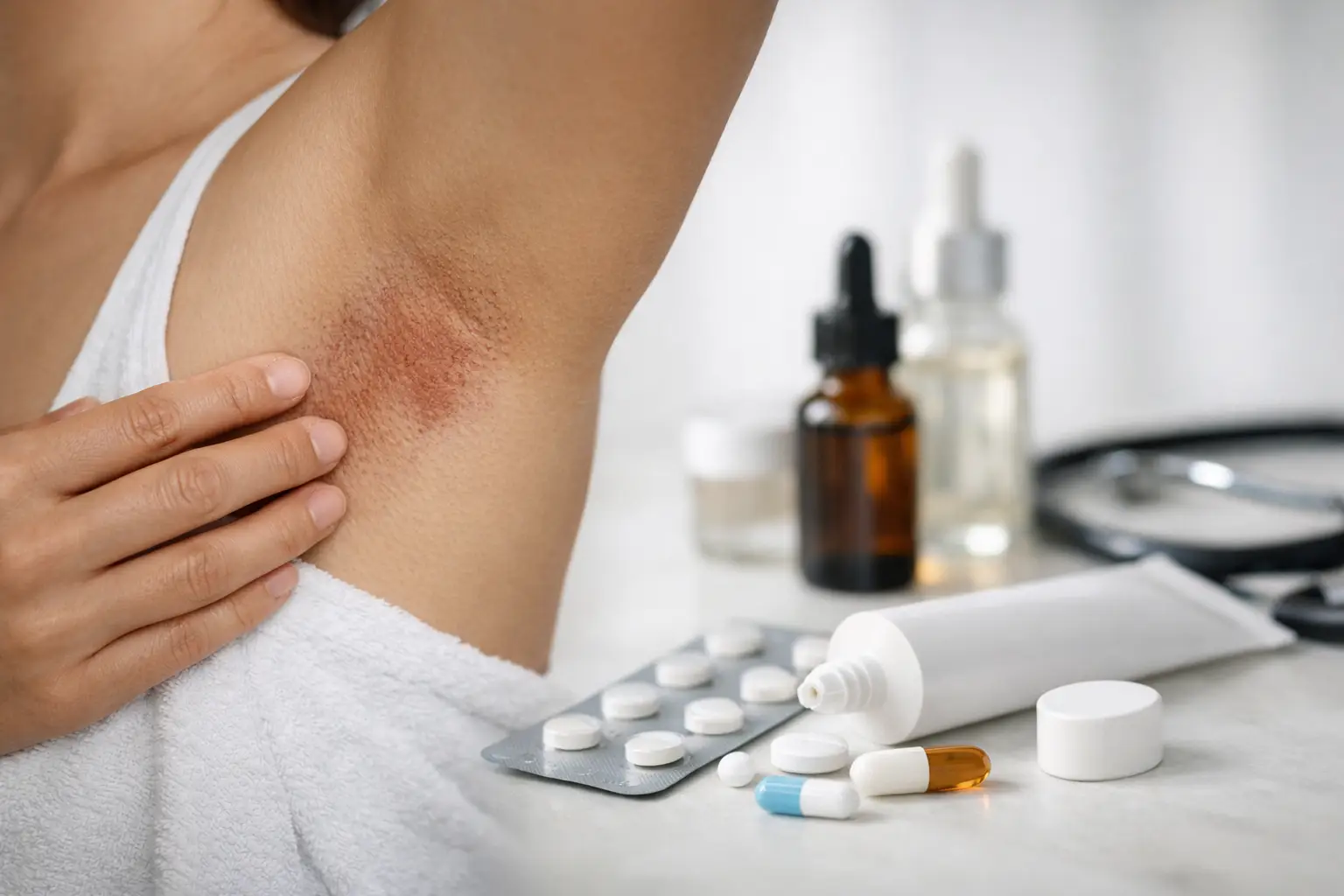
That brownish-red patch in the groin, underarm, between the toes, or beneath the breasts is easy to dismiss as a fungal rash. That is one reason erythrasma often lingers. When people search for erythrasma treatment options, they usually want one thing – a treatment that actually targets the cause, reduces odor and irritation, and helps stop the problem from coming back.
Erythrasma is a superficial bacterial skin infection, most often caused by Corynebacterium minutissimum. It tends to develop in warm, moist skin folds where friction, sweat, and limited airflow create the right environment for bacterial overgrowth. The rash may look sharply defined, slightly scaly, and brown, pink, or reddish. Some cases itch or burn. Others are more subtle and show up mainly as discoloration or persistent odor.
Because it can resemble fungal intertrigo, jock itch, or irritation from sweat, treatment is not always straightforward. The right approach depends on how extensive the rash is, where it is located, how long it has been present, and whether there is a mixed infection involving both bacteria and fungus.
Understanding erythrasma treatment options
Most erythrasma treatment options fall into three categories: local skin care and moisture control, topical antimicrobial treatment, and oral prescription therapy for more extensive or stubborn cases. The best choice depends on severity.
For mild and localized erythrasma, treatment often starts with the skin surface itself. Bacteria thrive when the area stays damp and occluded, so reducing heat, sweat, and friction matters. Keeping folds clean and thoroughly dry can help limit bacterial growth, but hygiene alone usually does not fully clear an established infection. It supports treatment. It rarely replaces it.
Topical treatment is usually the first practical step for limited disease. In more widespread cases, or when the rash keeps returning despite proper care, a clinician may recommend oral antibiotics. That can be effective, but it also raises the usual questions around antibiotic exposure, side effects, and whether the infection truly requires systemic therapy.
Topical erythrasma treatment options for mild to moderate cases
Topical therapy makes sense when erythrasma is confined to small areas and the skin is intact. Common prescription choices include topical clindamycin, erythromycin, fusidic acid where available, or benzoyl peroxide washes. These agents reduce bacterial load directly on the skin. For many patients, that is enough to clear visible patches over time.
The trade-off is that topical prescriptions are not always convenient to obtain, and some people want an over-the-counter approach first. That is where targeted non-prescription topicals can have a place, especially when they are formulated for bacterial and fungal skin overgrowth rather than positioned as generic moisturizers or cosmetic creams.
A condition-specific topical should do more than soothe the surface. It should support control of the infection environment while also helping relieve irritation, burning, discoloration, and odor. This matters because erythrasma is often not just a cosmetic concern. It affects comfort, hygiene, confidence, and daily movement.
Natural topical products can be a reasonable option when they are built around active compounds with anti-infective function rather than vague botanical claims. The quality of the formulation matters. So does matching the product to the condition. If a topical is designed for broad rash relief but does not address bacterial overgrowth, results may be limited.
When oral treatment makes sense
Some erythrasma cases are too extensive for a topical-only plan. If large skin folds are involved, if the infection has spread across multiple sites, or if prior treatment failed, oral antibiotics may be considered. Erythromycin is one classic option, though treatment decisions should be made by a licensed clinician based on the patient’s medical history and the exact presentation.
Systemic therapy can work faster for widespread infection, but it is not always the preferred starting point. Oral antibiotics expose the whole body to treatment for a condition that may be limited to the outermost skin layer. That does not mean they are wrong. It means they should be used thoughtfully. For people with recurring superficial bacterial skin problems, many want to avoid unnecessary systemic antibiotic use when a focused topical approach may be enough.
That concern is one reason antibiotic-free and naturally derived topical approaches have gained attention. For the right patient and the right severity level, they may offer targeted relief without moving immediately to prescription oral therapy.
Why the right diagnosis matters
Erythrasma is commonly confused with fungal infections, especially in the groin and between the toes. Both can cause redness, scaling, and discomfort. But the underlying cause is different. If the rash is bacterial and the treatment is aimed only at fungus, the response may be partial or poor.
A clinician may use a Wood’s lamp to help confirm erythrasma. Under that light, affected skin can show a coral-red fluorescence due to bacterial porphyrins. That is a useful clue, though not every patient gets evaluated this way before trying home care.
Misdiagnosis is also common because some patients have overlap. They may have erythrasma plus athlete’s foot, yeast overgrowth, or simple friction dermatitis. In those mixed cases, a single-product answer may not be enough. Treatment may need to address bacteria, moisture, and possible fungal involvement at the same time.
Supportive care that improves results
Even the best active treatment has a harder job if the environment stays favorable to bacteria. Skin fold infections tend to recur when moisture control is ignored. That is why supportive care should be part of any realistic plan.
Wash the area gently, then dry it completely. This sounds basic, but incomplete drying is a frequent reason these infections persist. A cool hair dryer setting can help with hard-to-reach folds. Loose, breathable clothing also helps reduce friction and sweat retention.
If the area is on the feet or between the toes, daily sock changes and better shoe ventilation matter. If the rash affects larger folds, weight management may help reduce recurrence over time, though that is a long-term factor, not a quick fix. People with diabetes should take persistent rashes seriously, because skin infections can become more complicated when glucose control is poor.
How to choose among erythrasma treatment options
The practical question is not just what can treat erythrasma. It is what makes sense for your case right now.
If the rash is mild, localized, and fairly recent, a targeted topical regimen combined with careful moisture control may be enough. If symptoms include odor, stinging, discoloration, and persistent irritation in friction-prone folds, a condition-specific anti-infective topical is often a reasonable first move.
If the area is extensive, recurrent, painful, or not improving, prescription evaluation becomes more important. The same is true if the diagnosis is uncertain. A rash that looks like erythrasma may actually be fungal, inflammatory, or mixed. Getting that distinction right can save weeks of ineffective treatment.
Consumers often compare natural OTC options with prescription antibiotics as if one must replace the other. In practice, it depends on severity and treatment goals. Mild superficial disease may respond to focused topical care. More stubborn disease may need escalation. The key is choosing a treatment intensity that matches the infection rather than automatically reaching for the strongest option first.
What to expect from treatment
Improvement is not always immediate. Odor and irritation may ease before discoloration fully fades. Brown or reddish patches can take longer to normalize even after bacterial control improves. That does not automatically mean the treatment failed.
What matters most is the overall direction. The area should gradually become less irritated, less moist, less odorous, and less sharply demarcated. If it worsens, spreads, cracks, or becomes painful, it is time for a medical assessment.
Recurrence is possible, especially in hot weather, in athletes, in people with hyperhidrosis, and in anyone dealing with ongoing friction or occlusion. That is why maintenance habits matter. Once the infection clears, prevention still deserves attention.
Theracont Scientific’s approach reflects a practical reality many patients already understand: superficial skin infections need targeted treatment, not generic skin care. When a product is designed specifically for bacterial and fungal overgrowth in high-friction areas, it aligns better with how these conditions behave in real life.
The most useful treatment is the one that addresses both the organism and the environment that lets it persist. If you are dealing with erythrasma, think beyond temporary symptom masking. Aim for a focused approach that treats the infection, controls moisture, and makes recurrence less likely. That is usually where lasting relief begins.