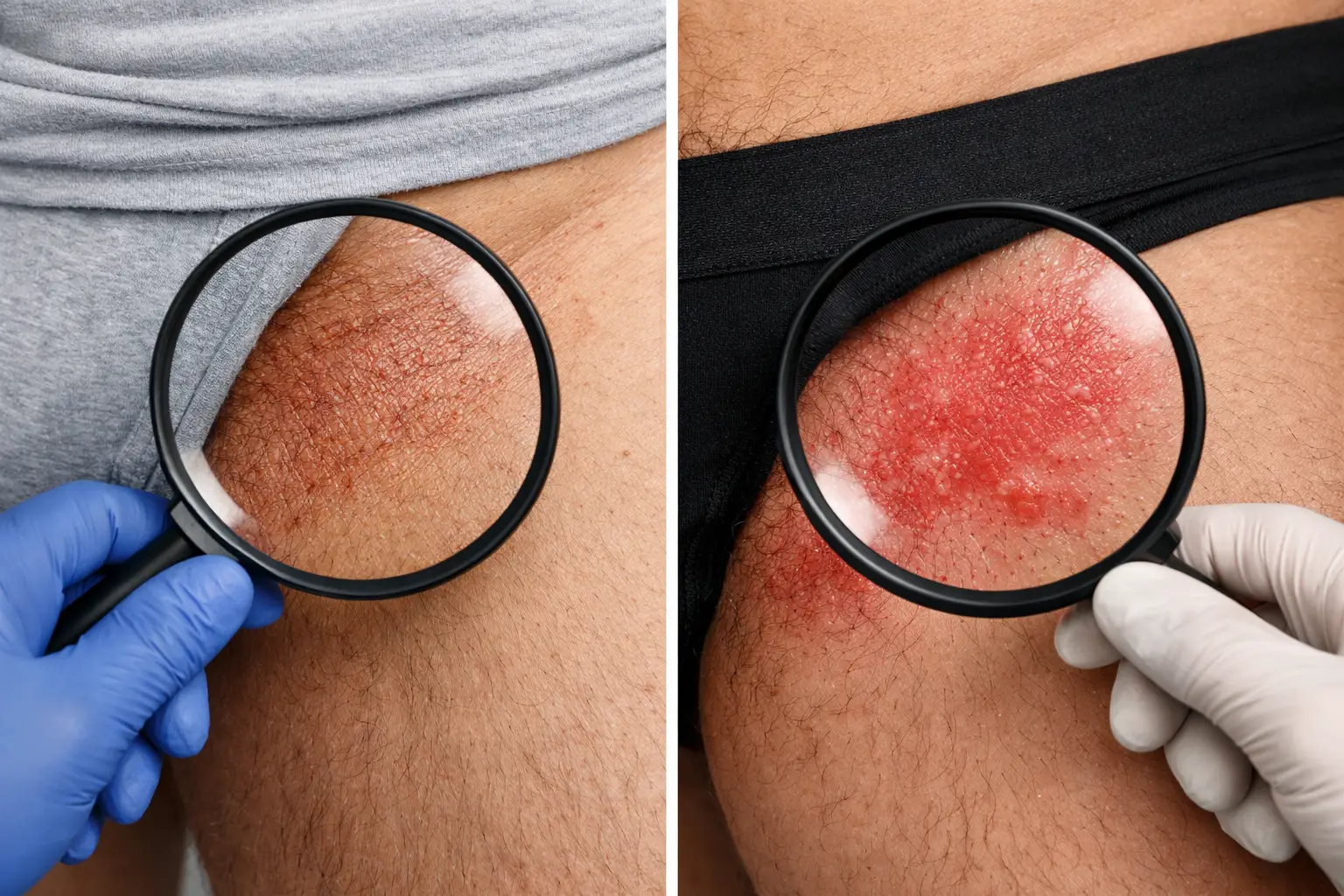
If you have a groin rash that will not clear, the question is usually not whether something is wrong. It is which infection you are dealing with. In the erythrasma vs jock itch discussion, that distinction matters because these conditions can look similar at first, but they do not come from the same type of organism and they do not respond to the same treatment approach.
Both conditions tend to show up in warm, moist, high-friction areas. Both can cause discoloration, irritation, and embarrassment. Both may worsen with sweating, tight clothing, or delayed drying after exercise. That overlap is why people often self-treat with the wrong cream for weeks, only to watch the rash persist or spread.
Erythrasma vs jock itch: the core difference
The simplest difference is the cause. Erythrasma is a superficial bacterial skin infection, most often linked to Corynebacterium minutissimum. Jock itch, also called tinea cruris, is a fungal infection caused by dermatophytes. One is bacterial. The other is fungal. That single difference drives everything that follows, from how the rash looks to what tends to work against it.
Erythrasma usually affects skin folds where moisture gets trapped, especially the groin, inner thighs, underarms, beneath the breasts, and between the toes. Jock itch also favors the groin and inner thighs, but it more often behaves like a classic fungal rash, with a defined border and active spread at the edge.
If you treat a bacterial condition like a fungal one, improvement may be limited or temporary. If you treat a fungal infection with a product aimed only at bacteria, you can run into the same problem. That is why visual clues, symptom pattern, and persistence all matter.
How the rash usually looks
Erythrasma often appears as a flat, well-defined patch with a brown, reddish-brown, or pinkish color. The surface may look slightly wrinkled or finely scaly, but not dramatically inflamed. In many cases, it looks dry rather than raw. The edges are usually clear, but not sharply raised.
Jock itch tends to produce a redder rash with a more noticeable border. The outer edge may be slightly raised, scaly, or more active-looking than the center. Sometimes the center starts to look clearer as the rash expands outward, creating a ring-like or arc-shaped pattern. That border activity is a classic fungal clue.
Color can help, but it is not enough on its own. Skin tone changes how both conditions appear. On lighter skin, erythrasma may look tan, pink, or red-brown. On darker skin, it may appear dark brown with subtle scaling. Jock itch can also shift in appearance depending on skin tone, irritation, scratching, and secondary inflammation.
Symptoms: itch, burning, and odor
Jock itch usually itches more. For many people, itching is the main complaint, especially with heat, sweating, or exercise. The area can also sting or burn if the skin becomes irritated from friction or scratching.
Erythrasma may itch, but it is often milder. Some people notice very little discomfort and focus more on the discoloration or the fact that the patch is not going away. Others notice a musty or unpleasant odor, especially when the infection sits in a skin fold for a long time. Odor is not exclusive to erythrasma, but it can be a useful clue when it is paired with a brownish patch and limited inflammation.
If the area is intensely itchy, visibly inflamed, and spreading along the upper inner thighs, jock itch becomes more likely. If the rash is flatter, darker, less inflamed, and oddly persistent in a moist fold, erythrasma moves higher on the list.
Where each condition tends to show up
Both conditions can affect the groin, which is why confusion is common. Still, distribution matters.
Jock itch usually involves the upper inner thighs and groin folds, but it often spares the scrotum. That pattern is typical of dermatophyte infection. It may also occur alongside athlete’s foot, since fungal organisms can spread from the feet by towel use, clothing, or hand contact.
Erythrasma often settles directly into body folds. The groin is common, but so are the underarms, between the toes, beneath abdominal folds, and under the breasts. When toe webs are involved, the skin may look macerated, discolored, and malodorous. In some patients, multiple fold areas are affected at the same time.
That broader fold pattern matters. If you have similar patches in more than one moist friction area, especially with odor and brownish discoloration, a bacterial process should be considered.
Why these infections get mistaken for each other
Warmth, moisture, and friction create ideal conditions for both bacterial overgrowth and fungal infection. People who sweat heavily, exercise often, wear occlusive clothing, have diabetes, carry excess weight, or spend long hours in uniforms or work gear are more prone to both.
The bigger problem is that early rashes rarely present like textbook examples. A fungal rash can become inflamed and messy. A bacterial rash can develop mild scaling and redness. Scratching, shaving, powders, deodorants, and over-the-counter creams can blur the picture further. By the time someone starts searching for answers, the original pattern may be harder to recognize.
Mixed infections can also happen. A person may have fungal involvement in one area and bacterial overgrowth in another, or a longstanding rash may create the kind of skin damage that invites secondary infection. When a rash partly improves but never fully resolves, that possibility deserves attention.
Erythrasma vs jock itch: how diagnosis is confirmed
A clinician can often make an initial judgment from the rash pattern and location, but confirmation may require a closer look. For suspected jock itch, skin scrapings may be examined to identify fungal elements. For suspected erythrasma, a Wood’s lamp exam is especially useful because erythrasma often fluoresces a coral-red color due to bacterial porphyrins.
That fluorescence is one of the most practical ways to separate the two. Jock itch does not produce that same coral-red glow. Still, washing the area shortly before an exam can reduce visible fluorescence, so the result is helpful but not perfect in every case.
If a rash is recurrent, widespread, unusually painful, or not responding to reasonable home care, getting the diagnosis right saves time and frustration.
Treatment depends on the organism
This is where many people lose weeks.
Jock itch responds to antifungal treatment. That may include topical antifungal agents plus practical control measures like keeping the area dry, changing out of sweaty clothing promptly, and treating athlete’s foot at the same time if it is present. If the feet remain infected, reinfection in the groin is common.
Erythrasma needs an antibacterial approach. Depending on severity and recurrence, treatment may involve topical antibacterial agents and consistent moisture control. Because erythrasma is superficial but persistent, targeted topical care is often central. A condition-specific natural anti-infective ointment can make sense for people who want focused non-prescription care without defaulting immediately to synthetic antibiotics, especially for mild to moderate cases being managed at home.
What does not work well is guessing indefinitely. If you have used an antifungal product correctly and the rash remains brown, flat, and stubborn, fungal infection may not be the main problem. If you have focused only on antibacterial care and the rash still has an itchy, expanding, scaly border, fungus may still be driving it.
What helps both conditions from a skin-care standpoint
Even though treatment differs, prevention overlaps. Both infections do better in damp, occluded environments. Daily control measures matter.
Dry the groin completely after bathing. Change underwear after sweating. Choose breathable fabrics when possible. Avoid sharing towels. If you have athlete’s foot, treat it promptly and put socks on before underwear to reduce fungal transfer. If skin folds stay moist through the day, reducing trapped moisture can improve treatment response as much as the ointment itself.
For recurrent cases, look beyond the rash. Friction, hyperhidrosis, blood sugar issues, and long work shifts in hot clothing can all keep the cycle going.
When to stop self-treating
A mild rash in the groin can be treated at home at first, but there is a point where persistence is information. If it keeps coming back, spreads despite treatment, becomes painful, starts cracking, or develops drainage, it needs a more precise evaluation.
You should also be more cautious if you have diabetes, reduced immune function, significant skin breakdown, or symptoms in multiple body folds. In those situations, what looks minor on the surface can become more complicated.
Theracont Scientific focuses on targeted topical care for bacterial and fungal skin conditions because broad, generic treatment is often the reason people stay stuck. The more accurately you identify the organism, the faster you can move toward real control instead of repeated trial and error.
If your rash has been written off as “just jock itch” but it is flat, brownish, persistent, and living in the folds, it may be time to consider that the problem is not fungal at all.