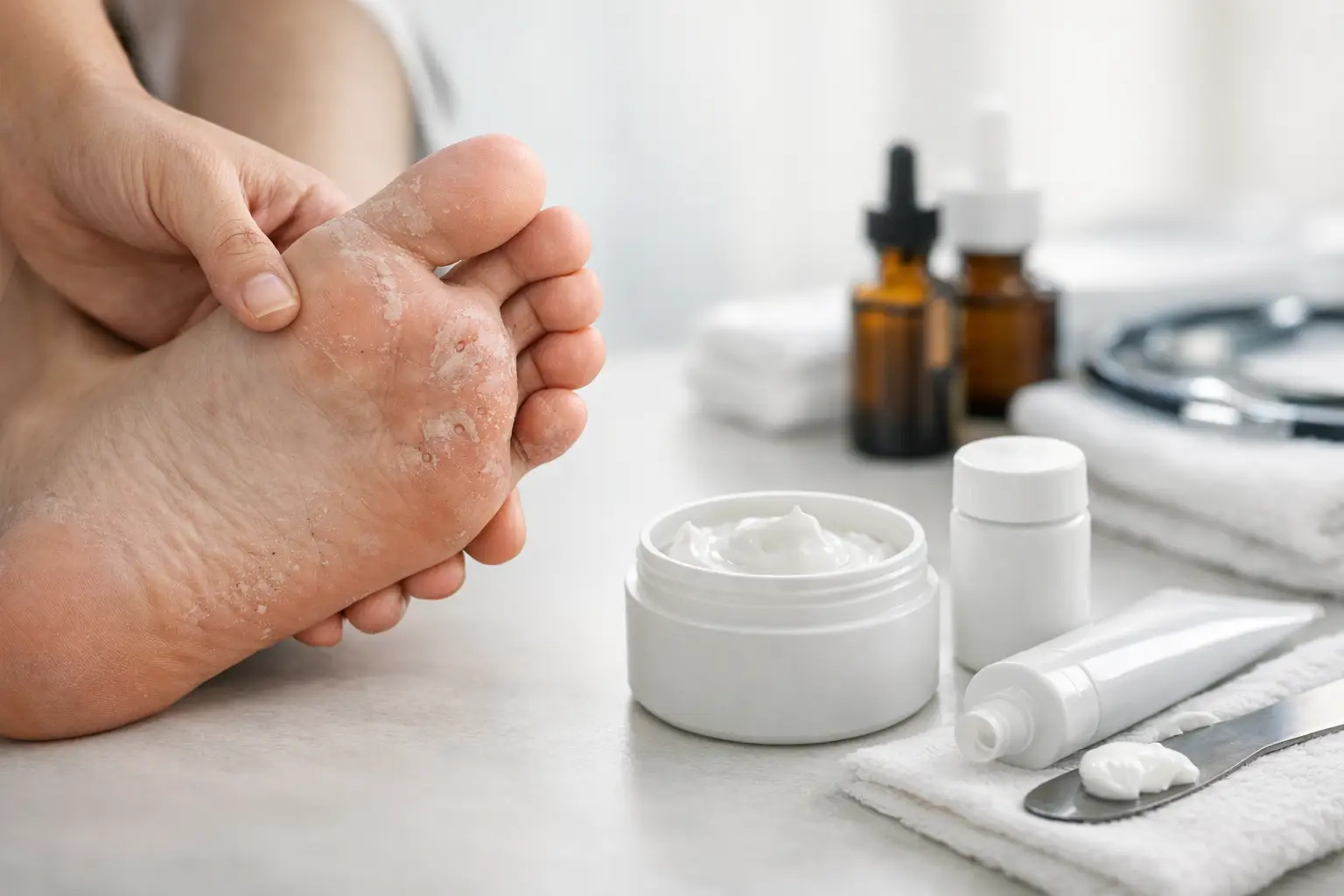
If your feet smell unusually strong even right after washing, and the skin on the soles looks dotted with tiny punched-out pits, you are probably not dealing with simple sweat or dryness. People searching for the best ointments for pitted keratolysis usually need something very specific – a topical treatment that targets the bacteria involved while also helping control the moisture and friction that let the condition keep coming back.
Pitted keratolysis is a superficial bacterial infection that commonly affects weight-bearing areas of the feet, especially the balls of the feet, heels, and toe pads. It tends to show up in people who sweat heavily, wear occlusive shoes for long hours, or spend much of the day in boots, sneakers, or work footwear that traps heat. The classic signs are shallow crater-like pits, white or soggy-looking skin, and a sour or sulfur-like foot odor that can be hard to ignore.
What makes the best ointments for pitted keratolysis?
The best ointment is not just a thick skin protectant. For pitted keratolysis, the real issue is bacterial overgrowth in a damp environment. That means a useful ointment needs to do more than soften skin. It should help reduce microbial burden, calm irritation, and work on skin that is often macerated from sweat.
This is where ingredient choice matters. Ointments marketed for general cracked heels or rough feet may feel soothing, but they often do little for the underlying infection. In some cases, heavy occlusive products can even make the environment wetter if they are applied too thickly on already sweaty feet and then covered by socks and shoes all day. The goal is targeted action, not just surface comfort.
A strong option typically includes topical antibacterial or anti-infective compounds, especially those used for superficial skin infections. Some consumers also look for plant-derived actives with known antimicrobial properties when they want an over-the-counter approach that avoids traditional synthetic antibiotics. That preference has become more common among people trying to manage recurring bacterial skin issues without immediately escalating to prescription antibiotics unless truly necessary.
Ointment vs cream vs gel
Texture affects performance more than many people realize. An ointment stays on the skin longer, offers prolonged contact, and can be useful when the affected area is localized and needs a more concentrated barrier of active compounds. That makes ointments a reasonable choice for pitted keratolysis, especially at night or during periods when your feet can stay dry and uncovered.
Creams are usually lighter and may be easier to use during the day. Gels can dry faster and may feel less greasy inside footwear. So when people ask about the best ointments for pitted keratolysis, the real answer is slightly broader: the best topical product is the one with the right antimicrobial activity and a base that fits your daily routine. If an ointment feels too heavy for daytime use, a patient is less likely to use it consistently.
Ingredients worth looking for
Topical products for pitted keratolysis should be judged by function, not marketing language. A product that promises fresh feet or smooth skin is not automatically a treatment product. What matters is whether the formula is designed for bacterial control in high-moisture areas.
Antibacterial botanicals and naturally derived anti-infective compounds can be helpful when properly formulated for skin application. Tea tree oil is often discussed because of its broad antimicrobial activity, but concentration and tolerability matter. Some people do well with it, while others find it irritating on macerated or sensitive skin. Oregano oil and thyme-derived compounds also appear in some targeted topical formulas for their antimicrobial potential, though strong essential oils can be too harsh if not balanced well.
Supportive ingredients also matter. Zinc compounds may help with odor and moisture control. Keratolytic support can help remove softened dead skin where bacteria thrive, but this has to be handled carefully. If the soles are already tender, overly aggressive exfoliating acids may sting and reduce compliance.
A condition-specific product is usually a better choice than a generic foot ointment because the formula is built around bacterial management, odor reduction, and symptom relief rather than simple moisturization. That targeted approach is often what separates a useful product from one that only makes the feet feel temporarily softer.
When a natural ointment makes sense
Many people with recurrent foot infections want an over-the-counter option before seeking prescription care. That is especially true when the condition is embarrassing but still mild enough to manage at home. A scientifically formulated natural ointment can make sense here if it is clearly positioned for bacterial skin conditions and not just sold as a cosmetic foot balm.
The advantage is practical. You get direct access to treatment, avoid the delay of a prescription visit, and may be able to address both odor and visible pitting early. For consumers who are also trying to limit unnecessary antibiotic exposure, a non-prescription anti-infective ointment can be an appealing first step.
That said, natural does not automatically mean gentle, and gentle does not automatically mean effective. A well-designed formula should be both active and tolerable enough for repeat use. If a product burns intensely, causes worsening redness, or leads to peeling beyond the original problem, it is not the right fit for your skin.
How to choose the right product for your case
Start with the pattern of symptoms. If the dominant issue is strong odor, soggy white skin, and small pits on the soles, a targeted antibacterial ointment may be enough when paired with moisture control. If the skin is also scaling between the toes, intensely itchy, or spreading to the sides of the foot, there may be a fungal component too. Mixed presentations are common, and treatment sometimes needs to address both bacteria and fungus.
You should also think about recurrence. If pitted keratolysis improves and then returns as soon as you go back to work boots or gym shoes, the topical product is only part of the answer. Repeated moisture exposure, friction, and sock occlusion keep re-seeding the problem. In these cases, the best ointment is the one you will actually use consistently while also changing the environment that feeds the infection.
A product from a company focused on condition-specific anti-infective skin care, such as Theracont Scientific, may be more useful than a general pharmacy moisturizer because the treatment goal is narrower and more therapeutic. That distinction matters when you need active control, not just cosmetic foot care.
How to get better results from any ointment
Application technique can make or break outcomes. Wash the feet, dry them thoroughly, and pay special attention to the areas between the toes and the weight-bearing parts of the sole. Then apply a thin layer to the affected zones. More is not always better. A thick coating under sweaty socks can increase occlusion.
Timing helps. Many people do best applying an ointment at night, when the feet can stay relatively dry and ventilated. If you need daytime use, try to pair treatment with clean moisture-wicking socks and a shoe rotation that lets footwear dry out fully between wears.
Odor control should not rely only on fragrance. If the smell is caused by bacterial activity, covering it up will not solve the problem. Washable insoles, absorbent socks, antiperspirant strategies for sweating, and reducing time in damp footwear all support the topical treatment.
When ointments are not enough
There are limits to over-the-counter care. If the pits are widespread, the skin is painful, the odor is severe despite treatment, or the condition keeps returning, it may be time for medical evaluation. A clinician may confirm the diagnosis and rule out look-alike conditions such as fungal infection, eczema, or other causes of plantar skin breakdown.
Prescription therapies are sometimes appropriate, especially in stubborn cases or when there is significant hyperhidrosis driving the recurrence. Some patients need stronger antibacterial treatment or separate management for excessive sweating. Others discover that what looked like pitted keratolysis was actually a mixed infection requiring a broader plan.
People with diabetes, neuropathy, poor circulation, or any immune compromise should be more cautious about self-treatment. Any foot infection in these settings deserves closer attention because skin breakdown can progress differently and healing may be slower.
What the best ointments for pitted keratolysis really do
The best products reduce the bacterial load, improve odor, calm irritation, and fit into a routine that keeps the feet drier over time. They are not magic by themselves. If you apply an excellent ointment but keep your feet in damp shoes for twelve hours a day, you are asking the product to work against the same conditions that caused the infection.
That is why the best choice is usually not the heaviest ointment or the most aggressively marketed foot cream. It is the one formulated for bacterial skin infection, tolerated well enough for repeated use, and paired with realistic moisture control. Once you treat both the bacteria and the environment, the skin has a much better chance to recover – and stay that way.
If your feet have been sending the same warning signs for weeks, the smart move is not to mask the odor or wait for it to pass. Use a treatment that is built for the condition you actually have, and give your skin a drier, cleaner setting in which to heal.